
LECTURER NOTES
Home | What is Control System| Fuzzy | Lecturer | Power | Transceiver
Find more type here...
System Performance
The reliability of the neural network pattern recognition system is measured by testing the network with hundreds of input vectors with varying quantities of noise. The script file appcr1 tests the network at various noise levels, and then graphs the percentage of network errors versus noise. Noise with a mean of 0 and a standard deviation from 0 to 0.5 is added to input vectors. At each noise level, 100 presentations of different noisy versions of each letter are made and the network’s output is calculated. The output is then passed through the competitive transfer function so that only one of the 26 outputs (representing the letters of the alphabet), has a value of 1. The number of erroneous classifications is then added and percentages are obtained.
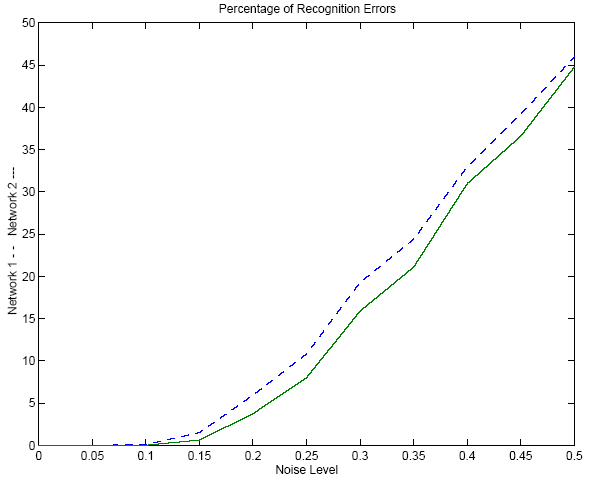
The solid line on the graph shows the reliability for the network trained with and without noise. The reliability of the same network when it had only been trained without noise is shown with a dashed line. Thus, training the network on noisy input vectors greatly reduces its errors when it has to classify noisy vectors.
The network did not make any errors for vectors with noise of mean 0.00 or 0.05. When noise of mean 0.2 was added to the vectors both networks began making errors. If a higher accuracy is needed, the network can be trained for a longer time or retrained with more neurons in its hidden layer. Also, the resolution of the input vectors can be increased to a 10-by-14 grid. Finally, the network could betrained on input vectors with greater amounts of noise if greater reliability were needed for higher levels of noise. To test the system, a letter with noise can be created and presented to the network.
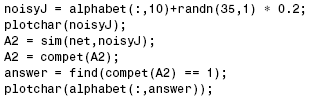
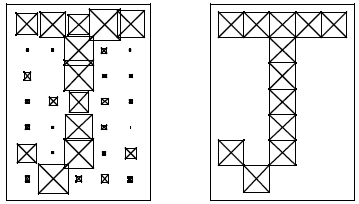
Here is the noisy letter and the letter the network picked (correctly).
S
ummaryThis problem demonstrates how a simple pattern recognition system can be designed. Note that the training process did not consist of a single call to a training function. Instead, the network was trained several times on various input vectors. In this case, training a network on different sets of noisy vectors forced the network to learn how to deal with noise, a common problem in the real world.
This material comes from any source reference and the copyright is own the author him self not this sites
Copyright 2009 (c) technosains.com All Rights Reserved