The square wave oscillator
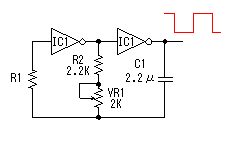
This is the square wave oscillator which used a CMOS-type
logic inverters. I use the word "logic inverter" to avoid confusion with
the DC/AC inverter. The output of the oscillator is connected with the
drive circuit through the logic inverters. The antiphase signal of the
alternating current is created using the logic inverter, too. Connect
the input of the logic inverters not to be using with the grounding to
avoid bad influence.
As for the operation of the oscillator which used logic
inverters, refer to "Square
wave oscillator (2)".
I chose resistance and capacitor for the oscillator in
the following value. I calculated that it was possible to set to 50 Hz
or 60 Hz with the variable resistor. Because there is an error of the
part in the actual circuit, it is a reference value.
Minimum frequency
| f |
= 1/( 2.2 x C x R ) |
|
= 1/( 2.2 x 2.2 x 10-6 x 4.2
x 103 ) |
|
= 1/( 20.328 x 10⁻³ ) |
|
=
49.2 Hz |
|
|
Maximum frequency
| f |
= 1/( 2.2 x C x R ) |
|
= 1/( 2.2 x 2.2 x 10-6 x 2.2
x 103 ) |
|
= 1/( 10.648 x 10⁻³ ) |
|
=
93.9 Hz |
|
|
In the measurement result in the actual circuit,
the minimum frequency was
43.6 Hz and the
maximum frequency was to 76.6 Hz
be.
The FET drive circuit
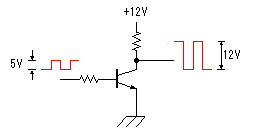
Because the output of the oscillator is the TTL of 0V to
5V, it is converted into the amplitude of vibration of 0V to 12V to
drive an FET with this circuit. It is not a special circuit.
The power MOS FET switching circuit
This is the switching circuit which is the main circuit
of the DC/AC inverter this time. I used C-MOS FET circuit by power MOS
FET. Two sets of C-MOS FET circuits are used and are controlled by the
antiphase.
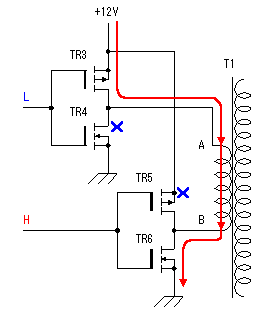
In case of the input of TR3 and TR4 are L level and
the input of TR5 and TR6 are H level, TR3 and TR6 become ON condition
and TR4 and TR5 become OFF condition. Therefore, the electric current
flows through the direction of A to B to the secondary coil(12V side) of
the transformer.
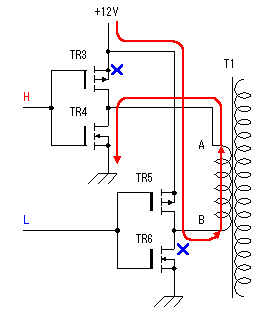
When the input level is opposite, TR3 and TR6 become OFF
condition and TR4 and TR5 become ON condition. Therefore, the electric
current which flows through the transformer becomes contrary to the case
of the above.
Either above-mentioned condition is
continued when the oscillator stops. Therefore, the big electric current
flows on the secondary side of the transformer.
The fuse must be put to protect.
Refer to "The
operation principle of C-MOS FET" about MOS
FET and the C-MOS circuit.
The +5V power circuit
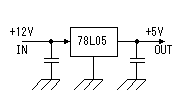
This is the circuit which is used 3 terminal regulator
for +5V. It is OK with the 100mA type because it is only to drive IC1.
|