I will report the performance evaluation result of the
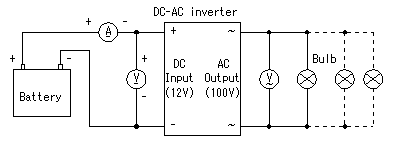
inverter which was made this time.As the test bed, a battery for the car
is used for the power supply and bulbs are used for the load.
The internal resistance of the
battery is very low and the big electric current (more over 100A) flows
through the terminal when short-circuiting. So, you must not make
short-circuit absolutely.
 The output
power measurement The output
power measurement
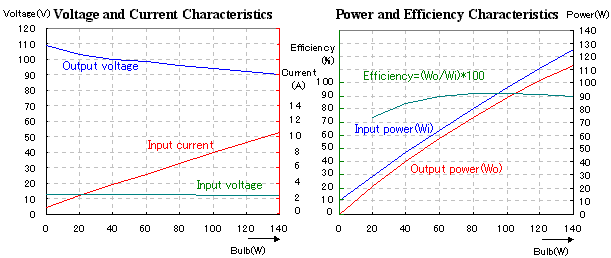
I measured the input voltage, the input electric current,
the output voltage when changing the wattage of the bulb of the load.
The output voltage falls when making a load big. The
consumption electric power of the bulb changes with the voltage. So, I
am converting to the consumption electric power according to the change
of the voltage. In this case, I assume that the resistance value of the
bulb doesn't change. However, the resistance value of the bulb changes
with the consumption electric power. So, the result has errors by this
conversion. Also, the voltage and the current are not sine wave. The
result has more errors. However, I judged that these errors didn't have
a big influence on the result.
 |
Ex. In case of the 60-W bulb
The resistance
value of the bulb = V2/W = (100)2/60 = 167
ohms
 (I assume that
this value doesn't change with the voltage.) (I assume that
this value doesn't change with the voltage.)
The consumption
electric power when the voltage is 98V = V2/R = (98)2/167
= 57.5 W |
When the output power is about 110W, the 10A electric
current flows through the input. This is the maximun rating of this
equipment. In this case, the output voltage is falling to about 90V.
When connecting any more load, the output voltage falls more. So, in
case of practical use, I think that the output of 120W is a limit of
this equpment.
The temperature
rise measurement
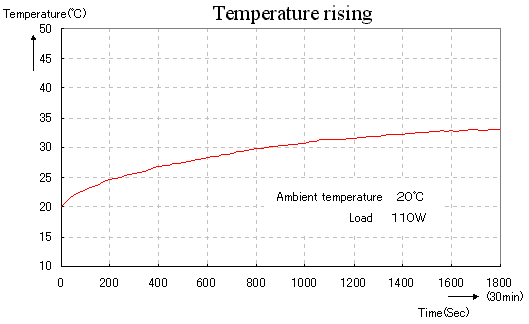
I measured the temperature rise of the FET when an
inverter is used in the continuous duty with the maximum load. The
measurement place is the heat sink which the FETs are put on. I put a
thermocouple thermometer to this part.
The output
voltage wave from
The output of this inverter is a square wave. When the
load becomes big, the wave from of the output voltage will be slightly
changed by the nature of a coil of the transformer.
There is to slightly change in the wave from of the
rising edge and the falling edge. However, I think that it is permitted
to say that it is changing hardly.

No loaded |

60W loaded |

110W loaded |
|